
Two Lawsuits, Five Weeks, One AI Voice: Law Firms Become the TCPA Defendant

Four personal injury law firms became TCPA class action defendants in July and August 2026. Two class actions, filed five weeks apart. Different courts, different plaintiffs' lawyers, different states.
Same alleged fact pattern: an AI voice on the phone, no consent in the file, and a consumer who said no and kept getting called.
If you buy legal leads, sell legal leads, or run an AI voice agent anywhere near an intake queue — this one is for you.
Case one: Sutton v. DV Injury Law and the AI voice that would not take no
Sutton v. DV Injury Law, PLLC, No. 3:26-cv-01884 (W.D. Tex., El Paso Division, filed July 10, 2026). Plaintiff's counsel is Mark Javitch.
Here is what the complaint alleges.
February 5, 2026. Emily Sutton's cell phone rings. The caller ID shows (817) 330-2564 — a number she says is not associated with any defendant and identifies none of them.
She answers. It isn't a person. It's an AI voice, and it starts asking about injuries.
She says the subject doesn't apply to her. It keeps going — more injuries, injuries to her family. She declines, repeatedly. It keeps soliciting.
When she asks who is calling, the voice says "DV Injury Law PLLC." When she asks for an address, it recites the Michigan address the firm publishes on its website.
She had never contacted them. She had never requested anything from them.
Case two: Nisman v. Wilshire Law Firm — an opt-out that only worked on paper
Nisman v. Wilshire Law Firm, P.L.C., No. 5:26-cv-08346-EJD (N.D. Cal., filed August 12, 2026). Plaintiff's counsel is Rachel Kaufman of Kaufman P.A.
Adam Nisman called Wilshire in early May 2026. He alleges he never gave his name, never gave his phone number, and never agreed to be called back.
Give Wilshire credit for the front end. The texts identified the sender — "Matt from Wilshire Law Firm," then "Carlos - Attorney at Wilshire Law Firm." They gave a callback number. Every one of them closed with "Text STOP to opt out."
On May 9 he replied "Stop." Then "STOP."
Then: three calls on May 9. Three on May 10. Three on May 12. Two on May 13. Three on May 14. More on May 17, May 24, May 28, and June 1. The complaint puts it at approximately seventeen calls after the stop request.
On May 12 he picked up. "Hi, this is Sophie from Wilshire Law Firm on a recorded line. I am calling about your recent interest in our services regarding a personal injury case. Do you have a moment to speak?"
Then scripted intake. Was this an auto accident? Tell us more about the incident.
The complaint alleges the voice sounded computer-generated, and that the pauses after each of his answers tracked a keyword-triggered system rather than a conversation between two people.
The correct opt-out language was there, however, exercising it did nothing.
Wilshire already agreed to pay $5.975 million for this
That's the part that should stop you.
In Ryan, et al. v. Wilshire Law Firm, P.L.C., No. 2025-022621-CA-01 (Fla. Cir. Ct.), Wilshire agreed to a settlement of up to $5,975,000 to resolve claims that it placed prerecorded calls to cell phones without prior express written consent. The class: everyone who received such a call from Wilshire or its agents between October 10, 2020 and February 18, 2026. Roughly 52,691 class members. Preliminary approval was entered February 18, 2026. The final approval hearing was set for June 3, 2026.
Now put the Nisman allegations on the same calendar.
February 18, 2026 — settlement class period closes
May 8 – June 1, 2026 — the calls Nisman alleges
June 3, 2026 — final approval hearing on the $5.975 million settlement
The conduct he describes falls after the class period closed, which is why he isn't a class member and can bring his own case. It also falls in the weeks immediately before the hearing to approve a nearly six-million-dollar settlement over the same category of conduct.
Take the allegations as allegations. The structural lesson survives either way: a settlement is a payment, not a remediation. Writing the check resolves the claims in the class period. It does not, by itself, change what the dialer does on Monday. If the money moves and the system doesn't, the class period just resets.
Why the AI voice claim is the whole ballgame under TCPA § 227(b)
Both complaints run the same core theory: an artificial or prerecorded voice to a cell phone, without prior express consent, under 47 U.S.C. § 227(b). Sutton pleads it as § 227(b)(1)(A)(iii). Nisman pleads the private right of action at § 227(b)(3).
The artificial voice claim skips the usual "is it an autodialer?" question. There is no equipment question to win. The plaintiff has to convince a factfinder of one thing: the caller wasn't a human being.
Your AI voice agent answers that question every time it opens its mouth.
The FCC closed the remaining door in February 2024. In re Implications of Artificial Intelligence Technologies on Protecting Consumers from Unwanted Robocalls and Robotexts, CG Docket No. 23-362, FCC 24-17 — AI-generated voices are "artificial" voices under § 227(b). No new rule was needed. The 1991 statute already reached the technology.
Nisman also cites Loyhayem v. Fraser Financial & Insurance Services, Inc., 7 F.4th 1232 (9th Cir. 2021), for the baseline consent rule. That case goes further than the complaint needs it to: in the Ninth Circuit, prior express consent is required for prerecorded-voice calls whether or not the call is telemarketing. There is no informational carve-out to retreat into.
Damages: $500 per call under § 227(b)(3)(B), up to $1,500 if a factfinder finds the conduct knowing or willful. Nisman puts roughly seventeen post-revocation calls on one man — $8,500 at the base rate, $25,500 trebled — and proposes a class of every cell number Wilshire reached with a prerecorded message in four years, which the complaint estimates "at least in the hundreds."
Sutton alleges thousands.
None of this is confined to legal services. I walked through the same claim run against a mortgage lender earlier this year. The vertical changes. The theory doesn't.
Texas found a second lever: mini-TCPA, solicitor registration, and barratry
Here is where Sutton stops being an ordinary TCPA case.
The complaint pleads four separate bodies of law off a single phone call.
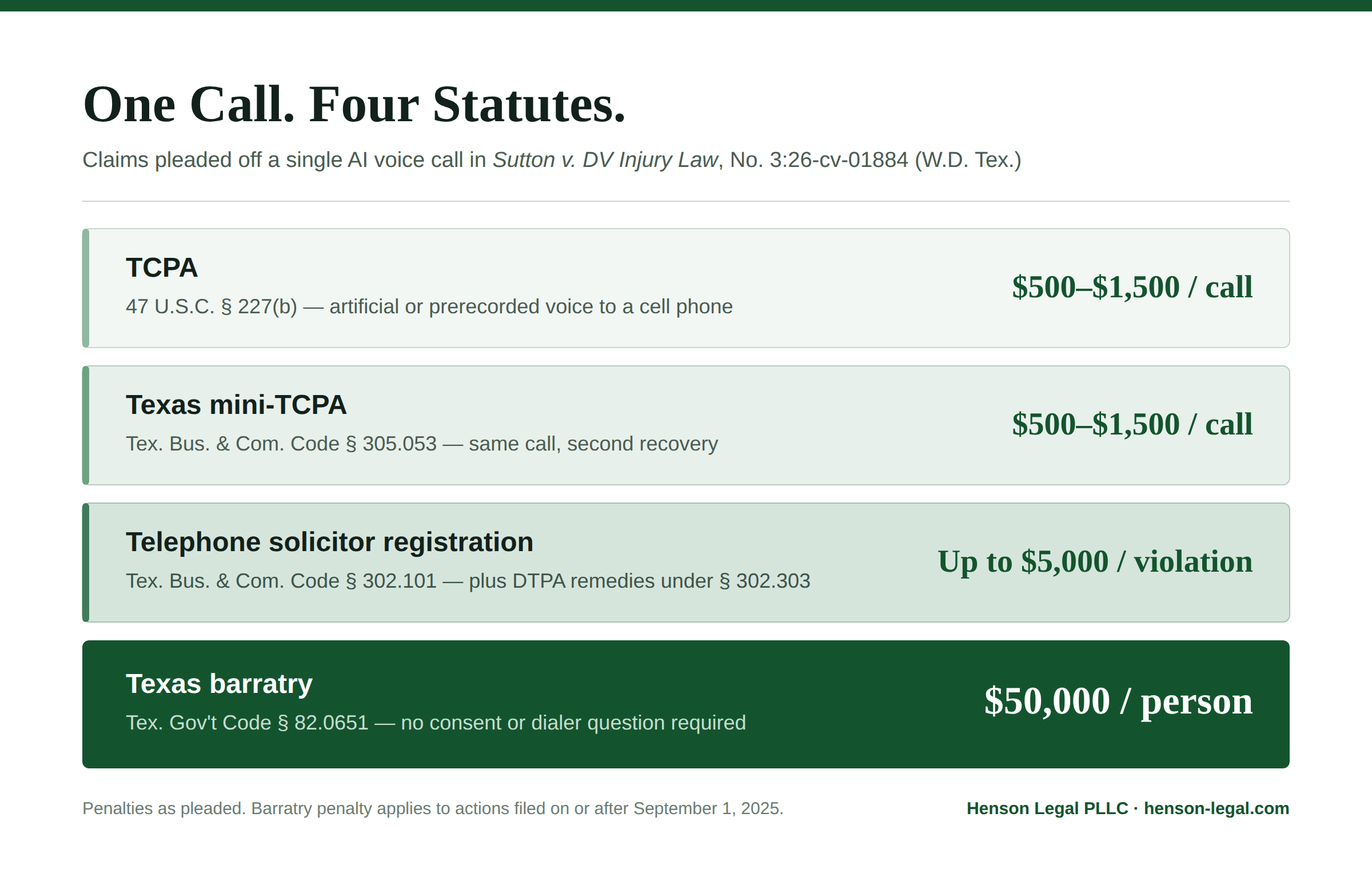
The claims pleaded off a single AI voice call in Sutton v. DV Injury Law, No. 3:26-cv-01884 (W.D. Tex.).
TCPA, 47 U.S.C. § 227(b). Artificial voice to a cell number without consent. $500 per call, up to $1,500 if the conduct is found knowing or willful.
Texas mini-TCPA, Tex. Bus. & Com. Code § 305.053. A person who receives a communication that violates § 227 may sue the originator under Texas law. Another $500, and the court may increase it to $1,500 for knowing and intentional violations. Same call, second recovery.
Texas telephone solicitor registration, Tex. Bus. & Com. Code § 302.101. You may not make a telephone solicitation to a purchaser in Texas without a registration certificate from the Secretary of State. Section 302.002 defines the solicitation to include one initiated by an automatic dialing machine or a recorded message device. Civil penalty of up to $5,000 per violation under § 302.302(a), plus costs and fees — and § 302.303 routes the violation into the DTPA, which puts economic damages, trebled for knowing conduct, plus attorney's fees on the table.
Texas barratry, Tex. Gov't Code § 82.0651. Read this one twice. Under Tex. Penal Code § 38.12(a), soliciting employment by telephone with intent to obtain an economic benefit is an offense. Section 82.0651 makes that conduct civilly actionable by the person solicited who did not sign a contract. The 2025 amendment set the statutory penalty at $50,000 for actions filed on or after September 1, 2025 — up from $10,000, per HB 4325 out of the 89th Legislature. That is on top of actual damages and attorney's fees, recoverable on the complaint's theory from each person who engaged in the barratry. This complaint names three.
The barratry count also does something the TCPA count cannot. It does not depend on what technology placed the call, and it does not depend on consent. It turns on whether legal employment was solicited by telephone. Strip the dialing technology out of the analysis and the certification fight gets a lot simpler for the plaintiff.
One call. Four statutes. Three defendants.
If you make outbound calls into Texas, the registration requirement is worth a same-day check — and Texas is not the only state where the exposure stacks. I mapped the highest-risk states for AI voice in June.
This didn't come out of nowhere: the regulatory turn on legal lead generation
Legal lead generation has been drawing regulatory attention from three directions at once, and it has been building for years.
State bar ethics authority. Missouri Informal Opinion 2025-05 held that a marketing company charging attorneys a per-lead "advertising fee" is running a lawyer referral service, and said the rule applies regardless of the name or characterization the service puts on the fee. Illinois Opinion 25-02 reached the same substance-over-label result where the charge was tied to placement. New York Opinion 1294 (2026) drew the permissive line — neutral, automated, no vouching, fee unrelated to retention. Florida sweeps lead generators into a single "qualifying provider" registration category under Rule 4-7.22. Texas requires a certificate under Occupations Code chapter 952 and, in Ethics Opinions 561 and 573, permits participation only where the matching is fully automated with no discretion exercised.
The through-line across all of them: it does not matter what you call the fee. I went deeper on how Colorado, California, and Texas rewrote lawyer marketing rules in June.
Federal telecom regulators. The FCC's February 2024 ruling put AI voice squarely inside § 227(b) with no rulemaking required, and its follow-on proceeding on AI-generated calls — which proposes disclosure at the outset of the call — has been open since 2024. Separately, since April 11, 2025, 47 C.F.R. § 64.1200(a)(10) requires that a revocation made by any reasonable means be honored within ten business days.
State legislatures. Texas raised its barratry penalty fivefold in 2025. That is a legislature deciding that telephone solicitation of legal work was worth a much bigger number.
Two class actions in five weeks is what happens when the plaintiffs' bar notices all three at the same time.
Replace "mass tort intake" with your business: what lead generators should check
Neither of these complaints is really about law firms.
Replace "personal injury intake" with "final expense," "solar," "mortgage refi," or "Medicare Advantage." Replace "Sophie" with whatever you named your voice agent. Replace "he called us first" with "she filled out a form in 2023."
Three failure points in these filings live in most stacks I review.
An inquiry treated as consent. Someone contacts you, your phone system captures the number, and it lands in a dialer nobody audited. An inbound call is not prior express consent to be robocalled back. Sutton adds the harder version of the same problem — the complaint alleges, on information and belief, calls placed from lead lists to numbers that had since been reassigned to new subscribers entirely. Most consent language I review is missing several of the fourteen elements that would close this gap.
A voice agent that answers to no consent record. If your AI voice can dial a number your consent database hasn't cleared, you have built a $500-per-call machine and pointed it at a class.
Revocation that doesn't propagate. Wilshire's own texts said "Text STOP to opt out." The complaint alleges the calls kept coming for three weeks after he sent it. Whether that's true is for the case to decide. But it is the most common gap I find: suppression lands in the SMS platform, never reaches the voice dialer, and never reaches the vendor.
For lead sellers specifically, read the agency section of Sutton closely. The plaintiff doesn't commit to who physically dialed. She pleads it in the alternative — the firms themselves, or a third-party telemarketing vendor acting as their agent — and then stacks every theory available: direct liability, common enterprise, actual and apparent authority, and ratification. That is TCPA vicarious liability pleaded four ways at once. Your buyer's exposure is your indemnification problem. And a caller ID that names none of the defendants is what turns a compliance failure into a willfulness allegation.
If you haven't audited your lead generation vendors against these theories, that is where I would start.
Questions we get about AI voice and TCPA liability
Are AI voice calls illegal under the TCPA?
Not inherently. But an AI-generated voice is an "artificial voice" under 47 U.S.C. § 227(b), per the FCC's February 2024 declaratory ruling (CG Docket No. 23-362, FCC 24-17). Calling a cell phone with one requires prior express consent — and because the voice itself supplies the violation, there is no autodialer question left to litigate.
Can a law firm be sued under the TCPA for lead generation calls?
Yes, and it is happening. Both cases here name law firms as defendants for calls soliciting legal representation. Sutton goes further and attributes a third-party vendor's calls to the firms through agency, common enterprise, and ratification theories — so hiring the dialing out does not move the exposure.
What is the penalty for barratry in Texas?
Under Tex. Gov't Code § 82.0651, a person solicited by prohibited telephone solicitation who did not sign a contract for legal services may recover a $50,000 statutory penalty, plus actual damages and reasonable attorney's fees, for actions filed on or after September 1, 2025. The penalty runs against each person who engaged in the barratry.
Does an inbound call to a business count as consent to be robocalled back?
No. An inquiry is not prior express consent to receive prerecorded or AI voice calls. Nisman alleges exactly that gap — he called the firm, says he gave no name or number, and says the calls followed anyway.
Does paying a TCPA class settlement fix the problem?
It resolves the claims inside the class period. It does not change the system. The Nisman allegations describe calls placed after Wilshire's prior settlement class period closed — which is the whole argument for treating remediation as an engineering project rather than a line item.
One thing to do this week: audit your AI voice agent's opt-out
Call your own AI voice agent. Say no three times.
Count the turns before it disengages. Then check what your caller ID actually transmitted — does it identify the entity that would be named in the caption? Then check whether the number you just called from is now suppressed in your SMS platform, your voice dialer, and your vendor's dialing list, and how long each one took to get there.
If the agent kept selling after the third no, if the caller ID doesn't name you, or if the three suppression lists don't match — you have the fact pattern alleged in both of these complaints. You just haven't been served yet.
That gap between "our disclosure says they can opt out" and "our systems actually stop" is a 30-minute conversation worth having before a plaintiff's lawyer has it for you.
