
Your AI Voice Needs a Better Memory: Audit Trail Requirements Nobody's Building
Double-click to edit...
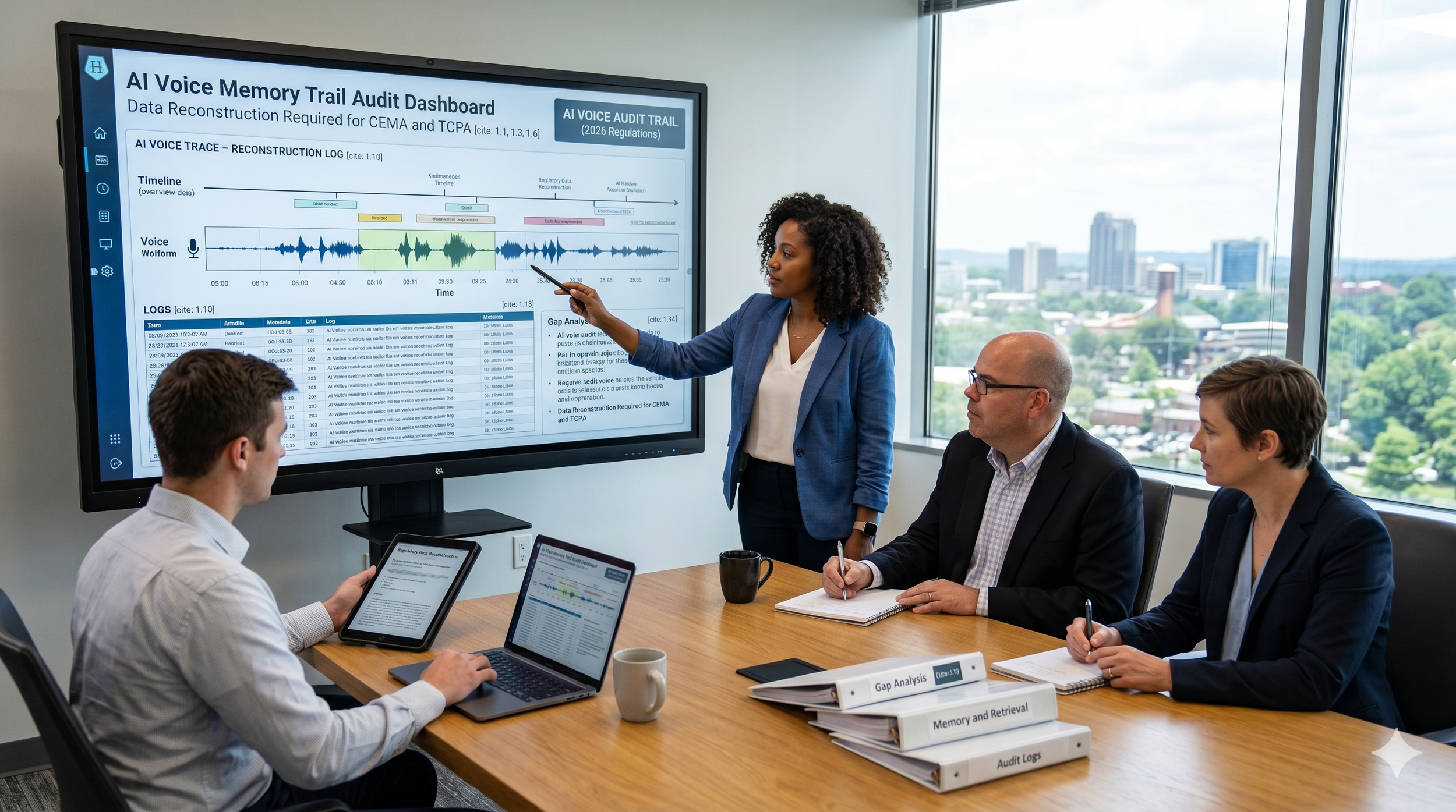
Most AI voice platforms are engineered to do one thing well: make the next call. Response latency, voice quality, conversation flow — that's where the engineering budget goes. And it should.
But here's the thing. The lawsuit doesn't come during the call. It comes two years later. And when it does, the first question isn't whether your AI agent said the right thing. It's whether you can prove it.
Right now, most platforms can't. But, the AI voice platforms taking AI voice compliance seriously are able to prove it. Not only are these platforms focusing on complying with the FCC’s AI voice consent requirements, but they are focusing on being able to prove compliance with those requirements. And they are able to protect themselves and the companies deploying their product.
The Retention Gap Nobody Talks About
The TCPA itself has no record retention requirement. Zero. The statute tells you what you can't do, imposes damages when you do it anyway, and says nothing about what records to keep.
But, that doesn't mean TCPA record retention is optional. The TCPA has a statute of limitations of four years, meaning you could be sued for a call you made four years ago.
The Telemarketing Sales Rule, however, requires five years of call records from the date the record is produced. Adding even more complexity, if your AI voice agent touches healthcare — and the platforms selling into insurance and benefits verticals almost certainly will — HIPAA demands six years of audit logs.
So the question isn't whether to retain records. It's whether you're retaining the right records. And for AI voice, "the right records" looks nothing like what most platforms are keeping today.
What Most Platforms Log
A typical AI voice platform logs what you'd expect from a traditional dialer: call start time, call duration, disposition, maybe the phone numbers involved. The better ones capture the call recording itself.
That's table stakes. It's what the TSR requires for any telemarketing call, AI or not. The ten elements under 16 C.F.R. § 310.5(a)(1)–(10) — the telemarketer, the seller, the subject of the call, outbound or inbound, consumer or business, calling and called numbers, date and time, duration, scripts used, caller ID transmitted, and call disposition — are mandatory for every call. The TSR five year recordkeeping requirements also require callers to maintain adequate consent records, including the consent language presented to the consumer.
But AI voice calls aren't traditional calls. The AI agent is making real-time decisions — choosing responses, evaluating sentiment, deciding when to escalate, determining whether to honor an opt-out request. Those decisions are invisible unless you build the infrastructure to capture them.
And when something goes wrong, "we recorded the call" isn't enough. You need to reconstruct why the AI did what it did.
What You Actually Need: Three Layers
Layer 1: Prompt Version Control
Every AI voice agent runs on a system prompt. That prompt defines the agent's personality, script, guardrails, escalation rules, and compliance instructions. It's the DNA of the call.
The problem is that prompts change. Product teams iterate. Compliance teams add disclosures. A/B tests swap instructions. And unless the platform captures the exact prompt governing each call at the time the call was made, there's no way to reconstruct what the agent was told to do.
The fix is straightforward: hash the system prompt at the time of each call and store a retrievable reference to the full prompt text. Not a pointer to "the current prompt." The actual text that was live when that specific call happened.
This isn't hypothetical compliance paranoia. FINRA's GenAI monitoring guidance — aimed at financial services firms but increasingly cited across industries — explicitly recommends tracking which model version was used and when. The logic applies directly to AI voice: if the agent's behavior changes because someone edited a prompt, you need to prove which version was running on the call that generated the complaint.
Layer 2: Safety Trigger Logs
AI voice agents have guardrails. Content filters. Escalation triggers. Fallback behaviors when the conversation goes off-script. These safety mechanisms exist precisely because AI doesn't always do what you expect.
When a safety filter fires — when the AI detects profanity, a legal threat, a request it can't handle, or a consumer saying something that triggers an escalation — that event needs to be logged. Not just that it happened, but what triggered it, what the AI did in response, and whether the response matched the intended behavior.
Why? Because safety triggers are the moments where the AI deviated from the script. In litigation, those are the moments that matter. A plaintiff's attorney isn't interested in the 47 seconds of smooth conversation. They want the three seconds where the AI mishandled an opt-out request, failed to escalate to a human, or continued a sales pitch after the consumer said stop.
If you can't produce a log showing what triggered the deviation and how the system responded, you're left arguing from the call recording alone. That's a fact dispute. Fact disputes go to juries. Juries are expensive.
Layer 3: Human Review Logs
FINRA's guidance doesn't stop at automated monitoring. It recommends human-in-the-loop review of AI outputs, including regular checks for errors or bias. For AI voice platforms, that means logging when a human reviewed an AI interaction, what they reviewed, and what they concluded. This human review is essential for ensuring the AI voice compliance audit is being done in accordance with best practices.
This matters for class certification defense. If a plaintiff argues that the platform's AI systematically mishandles opt-out requests, the platform's best defense is showing a documented human review process that catches and corrects errors. No review log, no defense.
The Discovery Problem Is Already Here
If the audit trail argument sounds theoretical, it isn't.
In early 2026, a federal court in the Southern District of New York addressed discovery of AI training data and prompt/output pairs in the OpenAI copyright litigation. The court rejected the argument that producing prompt and output logs was too burdensome, noting that no caselaw supports requiring a court to order the least burdensome discovery possible — or to explain specifically why it rejects a party's discovery proposal.
Read that again. The court said: if you have the data, you produce it. The burden argument doesn't get you out.
Now apply that to AI voice litigation. A TCPA class action alleging systematic consent violations. The plaintiff serves discovery requesting every system prompt used during the class period, every safety trigger log, every instance where the AI deviated from script. If the platform has that data, it produces it — and the data either proves compliance or it doesn't. If the platform doesn't have that data, it can't prove compliance even if the AI performed perfectly.
The absence of records doesn't create a presumption of innocence. It creates an inference problem. And inference problems in class actions tend to resolve against the party that should have kept the records but didn't.
The FINRA Template
Financial services firms are already building this infrastructure. FINRA's 2026 Annual Regulatory Oversight Report includes GenAI-specific guidance that reads like a blueprint for any AI voice platform:
Ongoing monitoring of prompts, responses, and outputs to confirm the system performs as expected. Storing prompt and output logs for accountability. Tracking which model version was used and when. Human validation and review, including regular checks for errors or bias.
FINRA regulates broker-dealers, not dialers. But the guidance is being cited across industries because it articulates what responsible AI oversight looks like. These sort of best practices are already showing up in some state regulations. When the FCC, FTC, or a state attorney general eventually issues AI voice-specific audit requirements — and they will — FINRA's framework is the likely template.
Platforms that build to this standard now won't have to retrofit later. Platforms that wait will be retrofitting under a consent decree.
Required Call Timestamps for AI Voice
One more operational detail that most platforms get wrong: timestamp granularity.
For AI voice compliance, you need more than call start and call end. You need timestamps at every legally significant moment during the call:
Call start. When the dialer initiates the outbound call.
Time to connect. When the called party picks up.
Greeting completion. When the called party finishes speaking their greeting — not when the line connects. This distinction matters because the TSR's two-second connect requirement and the abandoned call safe harbor both measure from greeting completion, not from call connect. Most platforms measure from the wrong event.
First AI response. When the AI agent begins speaking. This is the measurement that determines whether you're within the two-second window.
Consumer opt-out. The exact moment the consumer requests removal — keyword, natural language phrase, keypress, or callback to the opt-out line.
DNC recording. When the opt-out was added to the internal do-not-call list. The gap between opt-out request and DNC recording is discoverable, and a 24-hour gap looks very different from a 10-day gap in front of a jury.
Disconnect. When the call ends, to verify the platform allowed at least 15 seconds or four rings before disconnecting — a requirement under both the TCPA and TSR.
All timestamps should be in UTC. Calls cross time zones. State calling-hour restrictions are based on the called party's local time. UTC provides a single reference point that can be converted to any local time for compliance verification.
AI Voice Audit Trail Checklist
If you're using an AI voice platform, whether you're the platform or a company building an in-house voice agent, here's the audit infrastructure that will matter in litigation:
Per-call minimum: Call scenario, call recording link, lead ID (where applicable), campaign ID, and every TSR-required field, including required consent elements. This is non-negotiable.
Prompt versioning: Hash or version ID of the exact system prompt at call time, with a retrievable reference to the stored full text. Every prompt change creates a new version.
Safety trigger log: Every filter activation, every script deviation, every escalation event. Timestamped. Linked to the call record.
Human review log: Every instance of human supervision or review of AI outputs. Who reviewed, what they reviewed, when, and what action was taken
Revocation audit log: Every opt-out request — the detection method (keyword, natural language, keypress, callback), the verbatim consumer utterance, and confirmation that the number was added to the internal DNC list. Timestamped.
Tool call logs: Every DNC check, CRM lookup, or external system call the AI made during the conversation. Identified and timestamped.
Configuration change history: Every change to campaign settings, workflow rules, or AI behavior parameters. Who changed what, when, and what the previous setting was.
Retain everything for five years minimum. Six if you touch healthcare. The storage costs are trivial compared to a single discovery dispute over missing records.
The Bottom Line
AI voice platforms are building for speed and scale. They should be. But speed without memory is a liability.
The platforms that survive the first wave of AI voice class actions will be the ones that can reconstruct exactly what their AI was told to do, exactly what it did, and exactly when it did it — for every call, years after the fact.
Build the audit trail now. Hope is not a strategy. Neither is "we'll figure out how to get it later."
