
Do DNC Rules Apply to Text Messages, or Even Cell Phones? Four Courts, Three Attacks, and What Still Applies to Your Program

For twenty years, the answer to "do DNC rules apply to text messages?" was one word. Yes.
The FCC said so in 2003. Courts deferred. Plaintiffs' firms built a docket on it. If you texted a number on the National Do Not Call Registry without consent, twice in a year, you were looking at $500 per text in a class action.
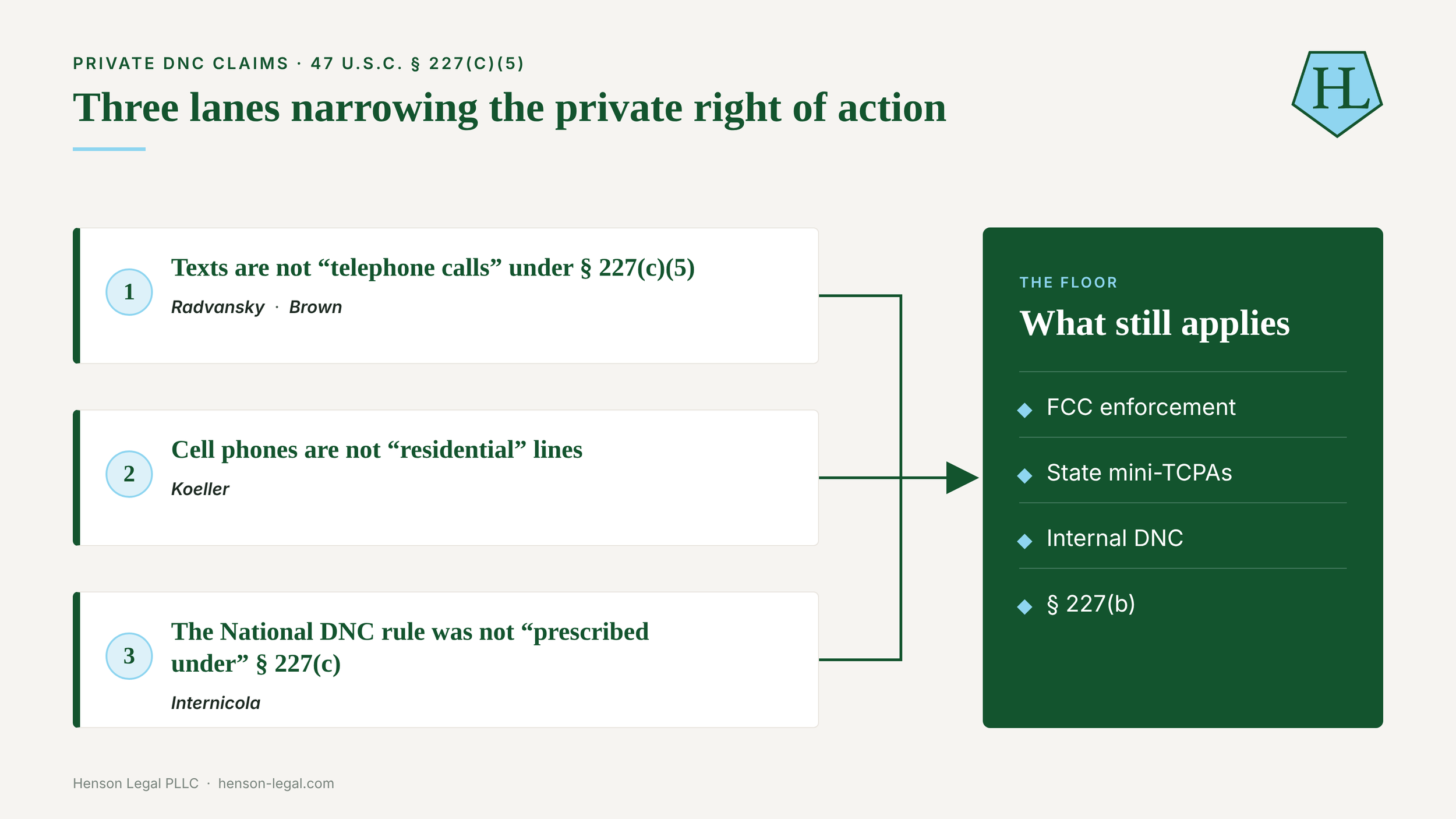
That answer is now a map. In the last two weeks of September 2026, four federal courts cut into the private DNC lawsuit from three different directions. One line of cases says texts are not "calls." Another says a cell phone is not a "residential" line, so even voice calls to it fall outside the private claim. The third says the National DNC rule may not be privately enforceable at all, whether you call or text.
Here is what happened, why, and what it means for your DNC compliance program.
Why This Is Happening Now: Loper Bright Reopened the TCPA
The private DNC lawsuit lives in one sentence of the statute. Section 227(c)(5) lets a person sue if they have "received more than one telephone call within any 12-month period by or on behalf of the same entity in violation of the regulations prescribed under this subsection."
Three pieces of that provision are now in play. "Telephone call." "Regulations prescribed under this subsection." And the "residential telephone subscribers" those regulations were authorized to protect.
For decades, neither got much scrutiny. The FCC interpreted the TCPA, and courts deferred under Chevron. Then came Loper Bright Enterprises v. Raimondo, 603 U.S. 369 (2024), which ended Chevron deference. A year later, McLaughlin Chiropractic Associates v. McKesson Corp., 606 U.S. 146 (2025), applied that principle directly to the TCPA: district courts are not bound by the FCC's interpretation. They read the statute under ordinary principles of interpretation, giving the agency "appropriate respect" and nothing more.
The Brown court put the shift bluntly. Before Loper Bright, the plaintiff "would have prevailed." It "was settled law that telephone calls included text messages based on a 2003 FCC order to that effect."
Settled law is now open law. Every TCPA standard that rested on an FCC gloss rather than statutory text is being retested. These four cases show how fast that is moving.
Radvansky v. 1st Class Medical: Five Texts, No Claim
The facts. Ethan Radvansky's cell number had been on the National DNC Registry since 2015. He used it as his personal number. In the spring of 2025, 1st Class Medical sent him five marketing texts. They were meant for someone else. He never gave permission. He sued on behalf of a class under § 227(c)(5).
The ruling. Judge Philip A. Brimmer dismissed the case with prejudice. He adopted the Seventh Circuit's reasoning in Steidinger v. Blackstone Medical Services, 182 F.4th 532 (7th Cir. 2026), on three points:
- Dictionary meaning in 1991. The TCPA does not define "telephone call." In 1991, a telephone was "an instrument for reproducing sounds at a distance." A telephone call meant communication by sound. Texts do not reproduce sound.
- Congress used different words on purpose. Other parts of § 227 use "telephone solicitation," which the statute defines to include a "call or message." Section 227(c)(5) uses only "telephone call." Different words, different meaning. The private remedy is narrower than the prohibition.
- The FCC's view does not control. The FCC extended DNC protections to texts under § 227(c)(3), which speaks of "telephone solicitations." That interpretation does not tell a court what "telephone call" means in § 227(c)(5). And after McLaughlin, the court would not be bound either way.
The footnote worth reading. The defendant also argued the plaintiff's cell phone was a business line, not a "residential" one. The court did not need to decide it, but said it would have rejected the argument at the pleading stage because the complaint alleged personal use. Hold that thought. A week later, a Missouri court took the residential question somewhere much bigger (see Koeller below).
Brown v. Hursh Group: Colorado Doubles Down
Five days later, the same courthouse did it again.
The facts. Hursh Group, doing business as Avid Demand, is a digital marketing agency. Trinceton Brown, a Utah resident on the Registry, alleged he received two unsolicited marketing texts from Hursh in November and December 2025. Class action under § 227(c)(5).
The ruling. Magistrate Judge N. Reid Neureiter (sitting by consent) granted the motion to dismiss with prejudice. He followed Steidinger and Radvansky and rejected each of the plaintiff's arguments:
- "Call" means any attempt to communicate by phone. Rejected. The statute's use of "telephone solicitation" elsewhere undercuts the argument rather than supporting it.
- The DNC Registry's purpose is privacy. Rejected. Policy and remedial purpose "cannot overcome the clear commands" of the text.
- The FCC's reading deserves respect. Rejected, for the same (c)(3) versus (c)(5) reason the Radvansky court gave.
The court also cited two more recent decisions on the same side: Rush v. Selectquote Insurance Services, 2026 WL 2495598 (W.D. Mo. July 30, 2026), and Conrad v. Hart Consumer Products, 2026 WL 2741623 (N.D. Ala. Sept. 16, 2026). The Alabama court's line will get quoted for years: "Consumers find spam text messages annoying. But they do not call text messages 'telephone calls.'"
Why two Colorado decisions matter. The Tenth Circuit has not ruled. Two judges in the same district reaching the same result in one week gives defendants a local body of authority, and it tells plaintiffs' firms that Colorado is no longer a friendly forum for text-only DNC claims.
Internicola v. MortgagePros: The Bigger Attack
Radvansky and Brown narrow the private DNC lawsuit to voice calls. Internicola questions whether the private lawsuit reaches the National DNC rule at all.
The facts. Daniel Internicola put his cell number on the Registry in 2008. In 2025 he engaged MortgagePros to refinance, then called on July 1, 2025 to end the relationship and withdraw his consent to be contacted. He alleges MortgagePros called three times that day, then sent texts on July 3, texts and three calls on July 7, and another text on July 9. He sued under two regulations: the National DNC rule, 47 C.F.R. § 64.1200(c), and the internal (company-specific) DNC rule, § 64.1200(d).
Holding one: texts are out. The magistrate judge recommended dismissing everything premised on texts. No one objected, and the district judge adopted it. That part tracks Steidinger.
Holding two: the National DNC rule is out. This is the new part. The defendant argued, and the court agreed, that § 227(c)(5) only creates a private right of action for "regulations prescribed under this subsection," and § 227(c)(2) required the FCC's rulemaking under that subsection to "conclude" within nine months of December 20, 1991.
The history the court walked through:
- The FCC's 1992 rulemaking under § 227(c) did not create a national registry. It required companies to keep their own internal do-not-call lists.
- The FTC proposed the National Registry in 2002 and adopted it in January 2003.
- Congress passed the Do-Not-Call Implementation Act in March 2003, directing the FCC to issue a final rule within 180 days.
- The FCC issued the rule that became § 64.1200(c) on July 25, 2003.
A 2003 rule is not a rule "prescribed" in a proceeding that had to end in 1992. Relying on Alexander v. Sandoval, 532 U.S. 275 (2001), which holds that only Congress can create a private right of action, the court held that § 227(c)(5) does not reach § 64.1200(c). The court contrasted § 227(b)(3), whose private right of action covers regulations "prescribed under this subsection" with no deadline attached.
What survived. The internal DNC claim under § 64.1200(d). MortgagePros argued that it honored the opt-out within a reasonable time. The court said that is a fact question it would not resolve on a muddled complaint, and ordered the plaintiff to replead the sequence of events on July 1. Leave to amend runs to October 2, 2026.
My read on the limits. Three things to keep in view:
- This is one district judge. The magistrate judge rejected the argument because MortgagePros cited no case adopting it. The district judge disagreed on the text. Expect plaintiffs to argue that the 2003 Implementation Act directed the FCC to finish a rulemaking "under the [TCPA]," and that Congress ratified the Registry later in 2003. Other courts may find that sufficient.
- The internal DNC rule has a better pedigree under this theory. The court's own history places the original internal-list requirement in the FCC's September 1992 order, which falls inside the nine-month window. The rule has been amended many times since, and defendants will test those amendments. But the core obligation to keep and honor an internal list is the part of the DNC framework most likely to survive Internicola-style arguments.
- Fights over which subsection a DNC rule comes from are not new. Courts split years ago on whether § 64.1200(d) was adopted under § 227(c), which has a private right of action, or § 227(d), which does not. See Fischman v. MediaStratX, LLC (E.D.N.C. 2021) (finding a private right of action). Internicola adds a timing argument aimed at the Registry rule itself.
Koeller v. OX AppSec: Cell Phones Aren't Home Phones
The first three cases are about texts and timing. Koeller is about the phone itself, and it involved voice calls.
The facts. OX AppSec called Edward Koeller's cell phone twice to sell cybersecurity products. On the first call he told them it was a personal number. OX emailed him ("hopefully we did not get off on the wrong foot by me calling you on your personal cell") and then called again. His number was on the National Registry. He had never been a customer and never consented. He sued under § 227(c)(5) for himself and a class, alleging both Registry calls and calls after he asked them to stop.
The ruling. Judge Matthew T. Schelp granted the motion to dismiss. The reasoning:
- The statute protects "residential telephone subscribers." Section 227(c)(1) authorized the FCC to protect "residential telephone subscribers' privacy rights." Every regulation enforceable through § 227(c)(5) rests on that authority.
- In 1991, "residential" meant a home phone. Using period dictionaries, the court held a residential telephone is "a telephone connected with a residence." A cell phone, "mobile and not connected to a house," is not one. The court borrowed this reading from Judge Ikuta's dissent in Chennette v. Porch.com, 50 F.4th 1217 (9th Cir. 2022).
- Congress knew how to say "cellular." Section 227(b) separately names calls to a "cellular telephone service" and to a "residential telephone line." Section 227(c) mentions only residential. Different words, different meaning.
- The FCC's 2003 presumption no longer controls. In 2003 the FCC said it would presume wireless numbers on the Registry are residential. After Loper Bright and McLaughlin, the court decided the question for itself and disagreed.
The court acknowledged that many Americans no longer have landlines. Its answer: updating the statute "is Congress's job, not the courts."
Why this one matters more than it looks.
- It reaches voice calls. Steidinger and its followers leave the call-based DNC claim intact. Koeller does not care whether you called or texted. If the number is a cell phone, the private claim fails.
- It reaches the internal DNC rule. Internicola's timing theory targets the 2003 Registry rule. Koeller's theory targets the "residential subscriber" limit that runs through all of § 227(c), including the internal do-not-call rule. Koeller pleaded a stop-calling claim, and it fell with the rest.
- It is not alone, but it is the minority. The court relied on Anthony v. Brian Marketing Group, 2026 WL 2685650 (S.D. Fla. Sept. 11, 2026), which reached the same result. But the court itself acknowledged that "many district courts" have gone the other way, holding that a cell phone used for residential purposes qualifies. It cited cases from Georgia, Florida, Oregon, Louisiana, and Illinois. No court of appeals has ruled.
My read. If Koeller's reading takes hold, the private DNC claim shrinks to voice calls to landlines. That is a sliver of modern telemarketing. It is also the most aggressive of the four theories, and the one with the most district courts lined up against it. Plan as if it loses. Watch it as if it might win.
The Other Side of the Split
Do not read these four cases as the national rule. They are not.
The week before Radvansky, a federal court in California went the other way. In Miller v. S. Brown & Associates, Inc., 2026 WL 2855518 (C.D. Cal. Sept. 22, 2026), the defendant asked the court to follow Steidinger. The court refused. It held that Ninth Circuit precedent, Satterfield v. Simon & Schuster, 569 F.3d 946 (9th Cir. 2009), and Howard v. Republican National Committee, 164 F.4th 1119 (9th Cir. 2026), treats texts as calls, and that district courts in the circuit apply that rule to § 227(c). Texts constitute a call under § 227(c), the court said, and the motion was denied.
A precision point that matters: Howard was a § 227(b) case, not a DNC case. There is no published circuit decision holding that texts are calls under § 227(c)(5). But district courts across the Ninth Circuit, and several in the Second, Third, and Fifth, keep treating texts as calls for DNC purposes. Florida has district decisions on both sides.
A Seventh Circuit rule on one side, Ninth Circuit district courts on the other. That is the kind of divide the Supreme Court eventually resolves.
The cell-phone question is earlier in the cycle. Koeller and Anthony say cell phones are not residential lines. Most district courts that have addressed it say a cell phone used for personal purposes is residential. No circuit has decided it.
What Did Not Change
This is the section that matters for operators. These rulings narrow one private remedy. They do not repeal the rule.
The FCC can still enforce. The DNC rules remain on the books. The FCC's enforcement authority does not run through § 227(c)(5). Neither does a state attorney general's.
State mini-TCPAs reach texts by their own terms. This is where text liability has been migrating, and these statutes do not care what "telephone call" meant in 1991:
- Texas SB 140 (effective September 1, 2025) expressly includes text, graphic, and image messages in "telephone solicitation," and opened direct private suits under the DTPA.
- Florida's FTSA covers texts, with a 15-day STOP-reply cure window before a claim exists.
- Oklahoma's OTSA reaches texts under a broader "automated system" definition than Florida's.
- Oregon HB 3865 (effective January 1, 2026) redefines telephone solicitation to include texts.
- Washington makes calling a number on the federal Registry a violation of state law, actionable under the Washington CPA.
- Pennsylvania Act 47 of 2026 takes effect October 18, 2026: texts covered, 9 a.m. to 7 p.m. window, no Sunday telemarketing, and a private remedy through the UTPCPL.
If a federal text claim closes, expect plaintiffs to replead under state law. Some already have.
Section 227(b) is a different provision. Steidinger and its followers addressed § 227(c)(5). Autodialer and artificial or prerecorded voice claims under § 227(b) have their own text and their own case law, including Howard.
Voice calls remain the core of private DNC exposure in most courts. Radvansky and Brown were text-only cases. In Internicola, the National Registry claim fell even as to calls, but the internal DNC claim based on calls is still alive. Koeller would take cell-phone calls out too, but most courts that have reached that question disagree.
Carriers still police texts. Carrier filtering and CTIA messaging standards do not wait for a court ruling. A texting program that ignores the Registry will feel it in deliverability before it feels it in a courtroom.
What to Do This Quarter
1. Do not turn off DNC scrubbing for texts. The federal private remedy is uncertain in some courts. The state remedies are certain. Scrubbing costs pennies. A Texas DTPA class does not.
2. Map your program by venue. Where are your recipients? Where are you incorporated? Where would you likely be sued? The answer to "can someone sue us over this text?" now depends on the circuit. A national texting program has national exposure, and the Ninth Circuit is the worst of it.
3. Treat your internal DNC list as your most important obligation. It survives Internicola's timing theory, it is the rule plaintiffs plead when they opt out and keep hearing from you, and Koeller is the facts plaintiffs love: told it was a personal cell, the caller emailed an apology and called again. That case was dismissed on a legal theory most courts reject. Do not count on drawing that judge. Make sure an opt-out on any channel suppresses every channel, and that it happens fast. The FCC's rules now require honoring revocation within ten business days. Internicola's internal DNC claim survived on three calls in the week after an opt-out.
4. Do not rewrite vendor contracts around these cases. If a lead vendor or texting platform wants to loosen DNC reps and indemnities because "texts aren't calls," the answer is no. The case law can flip in one appellate decision. Your indemnity should not.
5. Watch four things. Whether the Tenth or Eleventh Circuit takes up the texts question. Whether other courts adopt or reject Internicola's timing theory. Whether Koeller goes to the Eighth Circuit, which would make it the first appellate test of the cell-phone question. And whether the Supreme Court is asked to resolve the Seventh Circuit and Ninth Circuit divide.
The answer and the armor. The answer to "do DNC rules apply to our texts?" (and now, "to cell phones?") changed this month, and it will keep changing. That is the problem. A program built on today's case law breaks with the next opinion. The fix is a DNC policy that holds up in every jurisdiction you touch: federal Registry scrubbing, a cross-channel internal list, state-specific rules for Texas, Florida, Oklahoma, Pennsylvania, and Washington, and vendor contracts that put the risk where it belongs. If you want that built once instead of rebuilt every time a court rules, talk to us about a DNC Policy and Procedures package. For the full framework, start with our DNC compliance guide and the TCPA compliance overview.
